 humankind· Aug 19, 2026
Inside the UFO Crash Retrieval Files: Michael Schratt Reveals Stringfield's Military Witnesses
Researcher Michael Schratt presents firsthand military testimony of 119 UFO crash retrievals—craft, bodies, and cover-ups spanning decades of secrecy.
 ▶ Watch the replay on humankind
When researcher Michael Schratt takes the podium, he doesn't traffic in speculation. He deals in names, dates, locations—and the testimony of military personnel who held the bodies, loaded the craft, and took the secret to their graves. In a riveting presentation now available as a replay, Schratt unveils what he calls "the ultimate holy grail of UFO research": crash retrievals documented by the late Leonard Stringfield, the man who coined the term and spent three decades interviewing firsthand witnesses.
Who Was Leonard Stringfield—and Why Does His Work Matter Now?
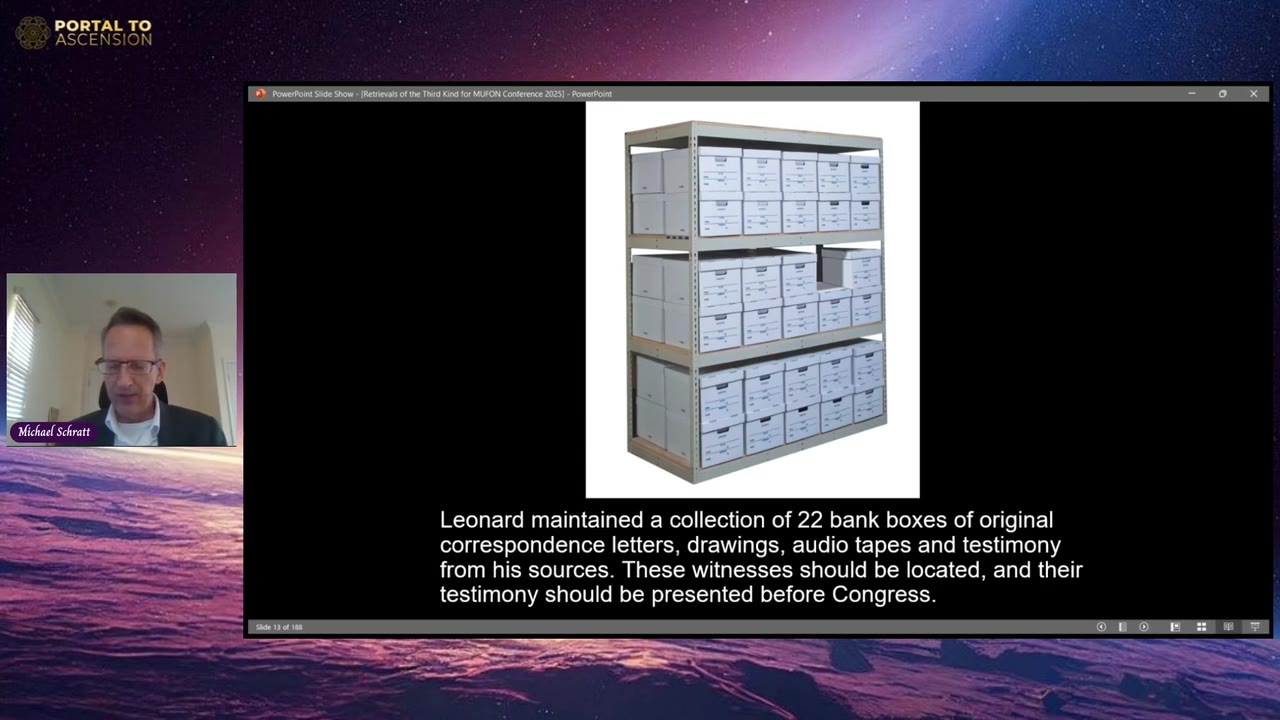
"This presentation is really an homage to Leonard Stringfield," Schratt begins, explaining how Stringfield—who memorized the entire dictionary by high school graduation and served in Pacific Theater intelligence during WWII—became the archivist of America's most explosive secret. Stringfield's 1978 Mufon Symposium lecture in Dayton, Ohio (miles from Wright-Patterson Air Force Base) "caused an international sensation" by presenting testimony from three-star generals, neurosurgeons, pathologists, and Pentagon officials.
The credentials matter. "We're talking about pathologists and doctors who examined the tissue samples, military personnel who recovered craft and loaded them onto 18-wheeler tractor-trailer lowboy trucks," Schratt emphasizes. Stringfield protected his sources' identities per agreement, but preserved 119 crash retrieval cases in meticulous status reports. "What I've collected has staggering implications for mankind," Stringfield wrote in 1993. "This would be the biggest thing since Christ."
Schratt connects the dots to today's congressional hearings. When whistleblower David Grush testified about "a multi-decade UAP crash retrieval program" and a "legacy program," Schratt is blunt: "What they're referring to in point of fact is Leonard Stringfield's crash retrieval witnesses. That's what they're referring to in these congressional hearings."
What Happened in These Retrieval Operations?
Schratt walks viewers through case after case, each backed by witness testimony and page references from Stringfield's publications. A 1942 army base north of Georgia: a 15-foot diameter craft with hieroglyphic writing, four crew members taken alive—"five feet tall, 90 pounds, large black eyes, milky white skin." A 1946 Wright Field incident witnessed by seven-year-old Tex Martin, whose father was an avionics mechanic: "He saw an 18 to 20-foot diameter dish-shaped craft... three deceased ET bodies on stretchers... two 18-wheeler tractor-trailer lowboy trucks with unknown tarped debris."
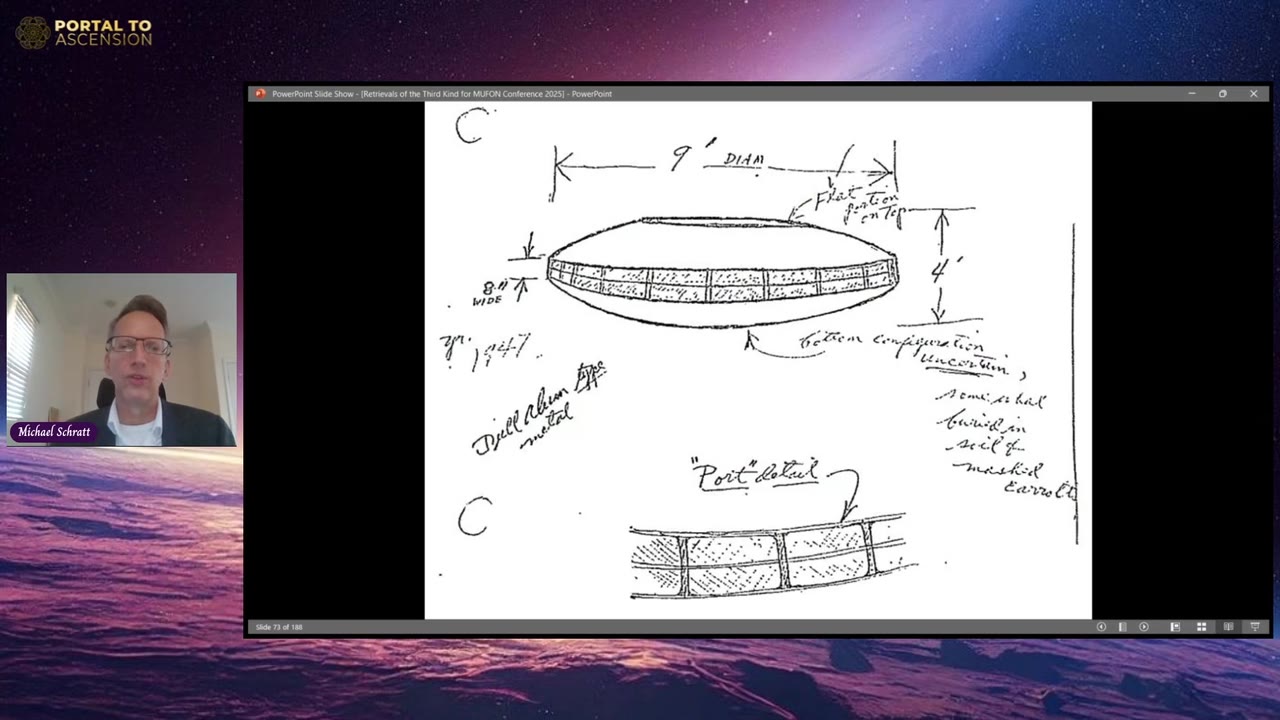
The details accumulate with forensic precision. White Sands, July 4, 1947: a 150-foot diameter craft, "excruciatingly well lit" with searchlights, military personnel with Geiger counters checking for radiation, photographers and motion picture cameras recording everything. Berkeley University, 1947: a 30-foot egg-shaped craft in a warehouse, "literally looked like a cracked egg," witnessed by metallurgical engineer Albert Bruce Collins. Salinas, California carrot patch, 1947: a nine-foot disc kicked by a 19-year-old farm worker before a "rapid response mobile crash retrieval team" arrived with convoy vehicles.
One of the most striking accounts comes from a Pentagon office worker, 1952: "She goes into this room, it's dimly lit... She sees a pickled alien in a large glass jar." Within seconds, military police escorted her out. Schratt's follow-up research? A 1989 news clipping: "New Defense Chief Gets Lost in Pentagon Basement"—Dick Cheney accidentally descending below the parking level. "Yes, it's very possible this could have happened somewhere within the bowels of the basement of the Pentagon."
Where Is the Evidence—and Who Controls It?
Schratt doesn't shy from the institutional dimension. An internal Stringfield source revealed top-secret files are "kept in three large computer banks spread throughout the country: Wright-Patterson Air Force Base, CIA headquarters Langley Virginia, NSA headquarters Fort Meade Maryland." The craft themselves? "NSA headquarters, McDill Air Force Base Tampa Florida, Seymour Johnson Air Force Base Goldsboro North Carolina." The strategy: compartmentalization and constant relocation of assets.
The presentation bristles with documentary evidence: Nathan Twining's 1947 letter to Air Force General George Schulgen stating "the phenomenon reported is something real and not visionary or fictitious." News clippings about foo fighters from WWII. Stringfield's own Mufon proceedings paper. "Actionable item," Schratt declares about the White Sands case where film was recorded: "Senators and congressmen with appropriate security clearances should track down and utilize this evidence for future public hearings."
The problem? "A lot of these senators and congressmen at congressional hearings, they don't have a need to know and have not been read into these programs. So how can they declassify... information about crash retrievals when they've never been briefed on it?"
Schratt's analogy is Vegas: "We're gonna go to the roulette wheel and there's 120 spaces... We're gonna lay down 119 bets for all of Leonard's crash retrieval witnesses. All we need is one of these to be correct and the whole concept of UFO crash retrieval non-existence completely falls apart."
In a wide-ranging Q&A, Schratt addresses the 1974 Coyame Mexico case, the 1996 Varginha Brazil retrieval, whether craft are gifted rather than crashed, the existence of a secret space program ("absolutely... extra-atmospheric for sure"), and whether recovered bodies are biological AI: "They're cookie cutters... we don't hear about motherships crashing... they don't come back to pick up their own."
The full presentation—complete with dozens of forensic illustrations by Rudy Gar and Joseph Christopher Payne, detailed case walkthroughs, and extensive source documentation—is available to watch now. As Schratt puts it: "What we need in the UFO community as a whole is the actual hardware. Within that hardware is the crash retrieval cases. That's why this is gonna be so critical."

Become a paid member and support humankind
Online members get access to member-only content and live streams.
Full members get access to all humankind in-person events and online content.