 humankind· 2h ago
Tracking Space Weather as an Inner Compass: Alexis Rose's Resonance Report #002
Alexis Rose guides viewers through solar cycles, coronal holes, and planetary transits—not as cosmic doom, but as a road map for the hypersensitive.
 ▶ Watch the replay on humankind
What if the pressure you've been feeling—the heaviness, the inexplicable fatigue, the sudden creative downloads—wasn't coming from inside you at all, but from the sun? That's the question Alexis Rose invites you to hold as she walks through her second Resonance Report, a weekly dive into the space weather shaping our inner and outer lives.
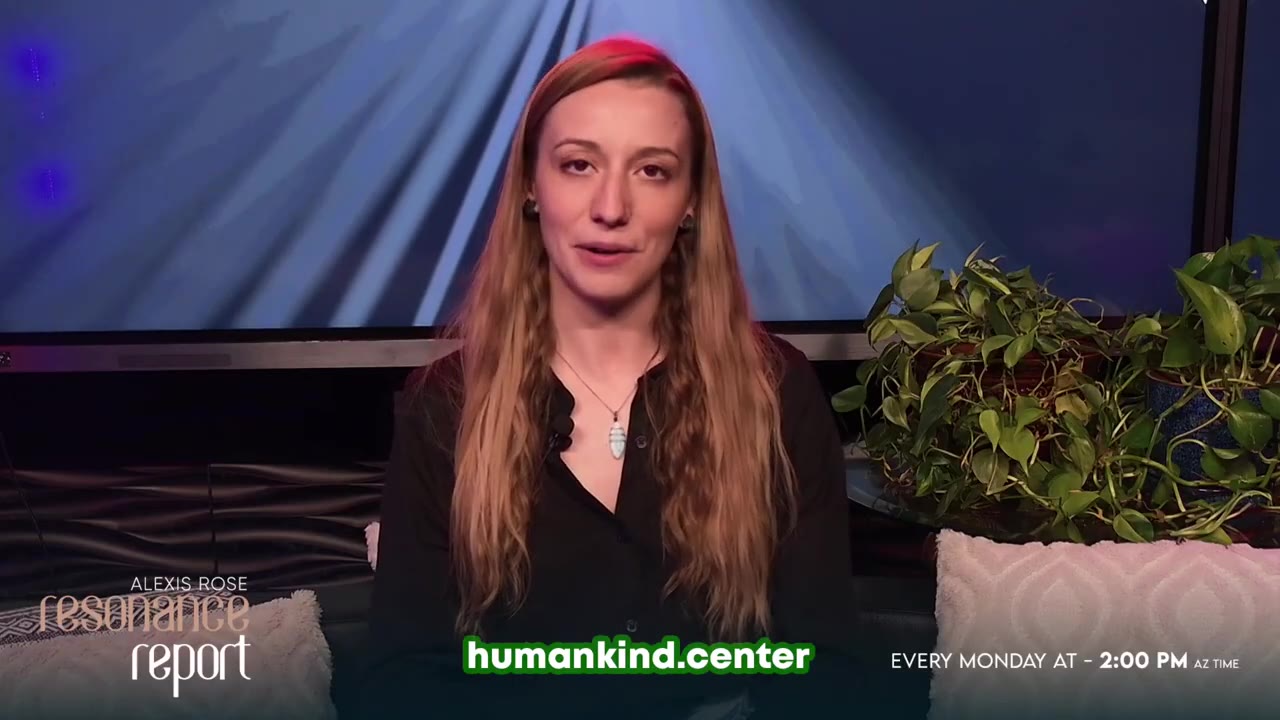
With no formal training in astrophysics, but a rigorous background in psychology and sociology, Alexis has spent years building what she calls a "do-it-yourself" study of how solar flares, coronal holes, planetary transits, and Earth's electromagnetic resonances influence human consciousness. She was the first person on Instagram to write #SchumannResonances, and her blog has become a lifeline for the hypersensitive—people who've long felt they were at the mercy of invisible forces, only to discover those forces had names, patterns, and rhythms.
What Happened This Week in the Solar System?
Alexis opens with the moon—waxing gibbous in Capricorn, heading toward a full moon in Aries. Then she gets to the headline: for the first time in solar cycle 25, the sun went spotless. Not for long—just a few hours—but long enough for everyone tracking the sun to take note. "It was a significant event," she says, a sign that solar cycle 25 is descending, calming down after years of intensity.
But quiet doesn't mean inactive. A massive coronal hole—described variously as a canyon or the hand-drawn Grinch—has been sending solar wind straight toward Earth. "What you've been feeling now, that pressure and that heaviness," Alexis says, "I would say is the coronal hole already in action." She forecasts maximum impact around September 22nd, urging viewers to take it easy on themselves.
She also walks through the week's planetary transits: Sun sextile Mars, Venus square Pluto, Mercury opposing Saturn. "Squares," she explains, "are a more uncomfortable geometry between the planetary bodies. There tends to be some type of tension and strain." If you had a rough day around the 18th, she says, Mercury opposite Saturn might be why.
Why Does a Psychology Major Track the Sun?
Midway through, Alexis turns personal. She shares the origin story behind her unlikely field of study. After completing her degree in psychology and sociology—and a further education credential—she was preparing to work with traumatized adults and children. Then she learned about Schumann resonances and solar cycles, information that had never been mentioned once in her "very expensive education."
Inspired by figures like David Wilcock and Dr. Joe Dispenza, who theorized that solar flashes could catalyze consciousness shifts, Alexis decided to test the theories herself. "I basically had to prove or disprove these theories, which were very popular and were freaking people out," she says. She started a daily blog, turned her own experience into a case study, and gathered feedback from followers worldwide.
What she discovered wasn't catastrophe, but coherency. Solar flares didn't wipe out infrastructure. Instead, they seemed to correlate with creative breakthroughs, vivid dreams, emotional releases, and—yes—physical exhaustion. "I wanted to see if I could find the fun and if I could find some coherency and some logic to it all," she explains. Over time, her study became a toolkit for navigating the invisible weather of consciousness itself.
Can Rocket Launches Punch Holes in Our Atmosphere?
One of the more provocative threads in this report is Alexis's tracking of rocket launches. She notes 18 launches since the previous episode—five from China, thirteen from SpaceX. She believes these launches can temporarily disturb the atmosphere and Earth's magnetic field, creating "chaos with the psychology, the consciousness of the people in vicinity."
On September 15th—the day China launched four rockets—data from the Tomsk, Russia monitoring station went missing for six hours. "I see this all the time," Alexis says. "It's tricky to study Earth's atmospheric response to the space weather, because if it's too big, it will likely get censored." She views these data gaps not as glitches, but as evidence of disturbances significant enough to warrant hiding.
She also challenges the popular framing of Schumann resonances as Earth's "heartbeat." "I personally believe that heartbeat is not the right concept," she says. Instead, she argues they're brainwaves—frequencies that perfectly align with mammalian brainwave states. "Our brainwaves perfectly entrain to this environment that we're born in." When that environment is disturbed—by solar wind, cosmic radiation, or human technology—we feel it in our bodies, our moods, our nervous systems.
Toward the end, Alexis offers a set of reflection questions: Have you looked at the sun this week? Have you discussed space weather with anyone? Have you had a significant dream? Have you hydrated enough during the coronal hole pressure? These aren't abstract prompts—they're practical anchors for people learning to read their own responses to an environment most of us were never taught to notice.
"This study has been a real liberator for me," Alexis says. For the hypersensitive, the chronically fatigued, the creatively blocked, knowing that some days are cosmically harder than others can be the difference between self-blame and self-compassion. "It's not your own brain chemistry turning on you. It's the conditions that you're currently in."
You can watch the full Resonance Report #002 to follow the charts, hear Alexis's full forecast for the coming week, and begin tracking the invisible weather for yourself. As solar cycle 25 descends and cosmic radiation increases, she promises, the next few years may bring revelations from beyond our protective bubble—"grander information," she calls it, waiting to be received.
Stream the replay now and start paying attention to what the sun is saying.
Become a paid member and support humankind
Online members get access to member-only content and live streams.
Full members get access to all humankind in-person events and online content.